Wandering through GPA data in math for spring 03 and fall 03 at the national campus
17 March 2004
As I sometimes tend to do, I grab some real statistics to use in MS 150. Sometimes I accidentally grab two pebbles in one fist. I was pulling data that I first pulled sometime in 1995 - GPA versus gender and state by subject. My spreadsheets are typically incomprehensible raw data. I attach such a useless file to this email. But I then paw through the pile and pull out numbers to use for MS 150. I was tearing apart the math data in particular tonight in preparation for both test two and chapter eight in MS 150.
I was looking specifically at performance by state and gender in math classes spring 2003 and fall 2003 and needed a set of 95% confidence intervals to see which of the means might be statistically significantly separated from each other and which might not. This generates a graph that looks like:
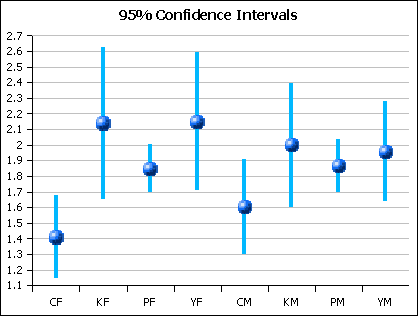
Where the first letter is the state code and the second letter is the gender on the horizontal axis. The vertical axis is the GPA, with the ball at the mean and the blue lines spanning the 95% confidence interval. Although this is by no means rigorous, it appears that the depression of the Chuukese female grades (n = 83) for spring 2003 and fall 2003 is statistically significant (p = 0.0023 two tailed) against the overall mean of 1.83 (not shown on the graph). No other group is statistically significantly lower, although the Chuukese men ( n = 81) may also be depressed depending on the level of confidence one chooses (p = 0.14 two tailed).
Not sure what this means, if anything, but I am aware that there was an incident involving the female Chuukese community last fall, followed by about a two to three week period before the issue was resolved. Although I am not at liberty to discuss the matter, this might have impacted the Chuukese community's performance.
Unfortunately the other confounding factor would be that the Chuukese students have a higher probability of coming in with a weaker foundation in mathematics. And that may be all we are seeing in this data.
The table of math data for spring 2003 and fall 2004 is as follows:
| Gender |
State |
Code |
sample size n |
mean |
stdev |
| Female |
Chuuk |
CF |
83 |
1.41 |
1.22 |
| Female |
Kosrae |
KF |
29 |
2.14 |
1.27 |
| Female |
Pohnpei |
PF |
296 |
1.85 |
1.35 |
| Female |
Yap |
YF |
47 |
2.15 |
1.50 |
| Male |
Chuuk |
CM |
81 |
1.60 |
1.37 |
| Male |
Kosrae |
KM |
40 |
2.00 |
1.24 |
| Male |
Pohnpei |
PM |
239 |
1.87 |
1.33 |
| Male |
Yap |
YM |
69 |
1.96 |
1.33 |
Other similar data can be drawn from the attached spreadsheet. The subject codes are usually the first two or three letters of the course code. All data is for the national site only. All kinds of other factors confound the picture when the whole six site campus is included.
The full table I was working with with p-values:
| Gender |
State |
Code |
sample size n |
mean |
stdev |
P(x) |
xp(x) |
0.05 |
SE |
Error |
low |
high |
mean |
tstat |
p |
| Female |
Chuuk |
CF |
83 |
1.41 |
1.22 |
0.09 |
0.13 |
1.99 |
0.13 |
0.27 |
1.14 |
1.68 |
1.41 |
-3.14 |
0.0023 |
| Female |
Kosrae |
KF |
29 |
2.14 |
1.27 |
0.03 |
0.07 |
2.05 |
0.24 |
0.48 |
1.65 |
2.62 |
2.14 |
1.3 |
0.2 |
| Female |
Pohnpei |
PF |
296 |
1.85 |
1.35 |
0.33 |
0.62 |
1.97 |
0.08 |
0.15 |
1.69 |
2 |
1.85 |
0.23 |
0.82 |
| Female |
Yap |
YF |
47 |
2.15 |
1.50 |
0.05 |
0.11 |
2.01 |
0.22 |
0.44 |
1.71 |
2.59 |
2.15 |
1.45 |
0.15 |
| Male |
Chuuk |
CM |
81 |
1.6 |
1.37 |
0.09 |
0.15 |
1.99 |
0.15 |
0.3 |
1.3 |
1.91 |
1.6 |
-1.48 |
0.14 |
| Male |
Kosrae |
KM |
40 |
2 |
1.24 |
0.05 |
0.09 |
2.02 |
0.2 |
0.4 |
1.6 |
2.4 |
2 |
0.87 |
0.39 |
| Male |
Pohnpei |
PM |
239 |
1.87 |
1.33 |
0.27 |
0.5 |
1.97 |
0.09 |
0.17 |
1.7 |
2.04 |
1.87 |
0.42 |
0.68 |
| Male |
Yap |
YM |
69 |
1.96 |
1.33 |
0.08 |
0.15 |
2 |
0.16 |
0.32 |
1.64 |
2.28 |
1.96 |
0.79 |
0.43 |
|
|
|
884 |
1.87 |
1.33 |
1 |
1.83 |
1.96 |
0.04 |
0.09 |
1.78 |
1.96 |
1.87 |
0.92 |
0.36 |